Best Evaluation for Sensory Processing Concerns
Parenting, Pediatric Occupational Therapy, Sensory Processing
What's the Best Evaluation for a Child with Sensory Processing Concerns?
A comprehensive private occupational therapy assessment is usually the best evaluation for a child with sensory processing concerns because it examines how sensory differences affect daily life, behavior, motor skills, emotional regulation, school participation, and independence.
Why Parents Ask About Sensory Processing in the First Place
In my experience as a pediatric occupational therapist, many parents start by asking whether their child has sensory processing difficulties. What they really want to know is why everyday activities feel harder than they should and what support would actually help. A thorough occupational therapy evaluation is often the assessment that provides those answers, moving families from worry and guesswork to clarity and a practical plan.
Key Takeaways at a Glance
A private occupational therapy assessment is typically the most comprehensive evaluation for sensory processing concerns.
Sensory processing challenges are not diagnosed through a single test or medical scan; they are understood through behavior and function over time.
The best evaluations combine parent interviews, clinical observations, standardized assessments, and functional analysis.
School evaluations often focus on educational impact, while private assessments usually provide a broader picture of the whole child across settings.
Sensory concerns frequently overlap with motor, emotional regulation, attention, and developmental challenges, so these areas should be considered together.
The evaluation should result in clear recommendations and next steps, not just a list of scores or labels.
📌 Key Takeaway: The “best” evaluation is the one that explains your child’s challenges in everyday life and gives you a concrete plan for support, not just a diagnosis.
Why Occupational Therapy Is Usually the Best Starting Point
Sensory processing affects how children respond to information from their environment and their bodies. Difficulties may appear as:
Extreme sensitivity to sounds, textures, clothing, or movement
Constant movement and sensory seeking, such as crashing, jumping, or spinning frequently
Frequent meltdowns during routines like getting dressed, brushing teeth, or bedtime
Difficulty sitting still during school tasks or meals, even when motivated to participate
Avoidance of grooming activities such as hair brushing, nail trimming, or bathing
Challenges with emotional regulation, including big reactions to seemingly small triggers
Coordination and motor planning difficulties, like trouble learning new movements or appearing clumsy
Because these concerns affect everyday functioning, occupational therapists are specifically trained to evaluate how sensory processing impacts participation at home, school, and in the community. Unlike evaluations that focus primarily on diagnosis, an OT assessment focuses on function: What is getting in the child's way, why is it happening, and what can help?
💡 Pro Tip: If your main questions are about daily routines, behavior, school participation, or independence, an occupational therapy evaluation is usually the most practical first step.
Why There Is No Single “Sensory Processing Test”
One of the most important things for families to understand is that sensory processing challenges are not diagnosed through a single test or medical scan. There is no MRI, blood test, or quick screening that can definitively say whether a child has “sensory processing disorder.” Instead, sensory processing is understood by looking at:
How a child behaves and responds in real-life situations over time
Patterns of strengths and challenges across different environments (home, school, community)
How sensory input (sound, touch, movement, etc.) affects emotions, attention, and participation
This is why the most accurate understanding comes from a comprehensive occupational therapy assessment that pulls together multiple types of information rather than relying on a single score or checklist.
What Should a Sensory Processing Evaluation Include?
The best evaluations do much more than administer a questionnaire. A comprehensive assessment typically includes several key components that work together to create a full picture of your child. At minimum, a high-quality OT evaluation for sensory concerns should incorporate:
Component Purpose Parent interview Understand concerns, history, and daily challenges from the family’s perspective. Clinical observations Observe sensory responses and regulation in real-life activities and structured tasks. Standardized assessments Measure sensory, motor, and functional skills using tools with established norms. Fine motor testing Identify handwriting, grasp, and coordination concerns that may be linked to sensory processing. Visual motor testing Examine how eyes and hands work together for tasks like copying, puzzles, and drawing. Self-care assessment Evaluate dressing, feeding, hygiene, and independence in daily routines. School participation review Understand classroom impact, attention, behavior, and peer interactions when possible. Written report Summarize findings and provide clear, actionable recommendations for home and school.
When I evaluate a child with sensory concerns, I am rarely looking only at sensory processing. I am also exploring motor skills, emotional regulation, executive functioning, and participation in daily activities because these areas are often interconnected. For example, a child who appears inattentive in class may be overwhelmed by sound, struggling with postural control, or working hard just to sit upright, leaving less energy for listening and learning.
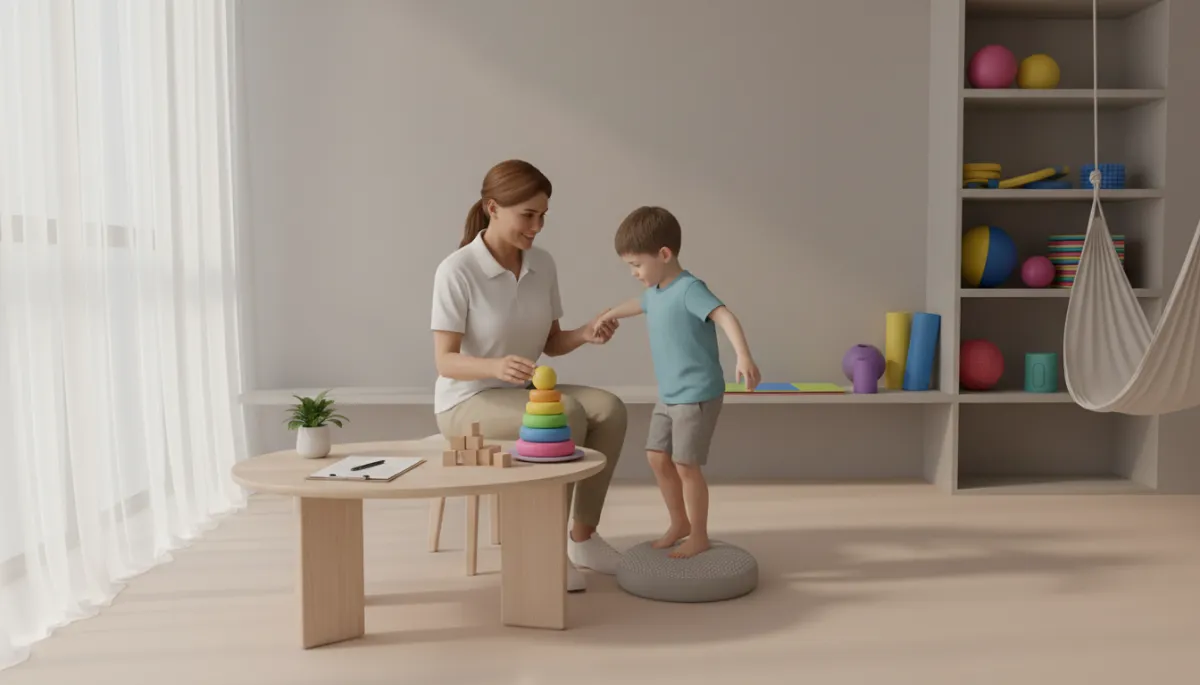
-toned therapy room where an occupational therapist is gently guiding a child through balance...
Combining observation, testing, and parent input creates a clearer picture than any single score.
Which Sensory Assessments Are Commonly Used?
Sensory Profile 2
One widely used tool is the Sensory Profile 2, a caregiver questionnaire that measures sensory patterns across different environments. It helps identify whether a child tends to:
Seek sensory input (for example, constantly moving, touching, or crashing into things)
Avoid sensory input (such as covering ears, refusing certain textures, or withdrawing from busy settings)
Be overly sensitive (reacting strongly to sounds, clothing tags, or light touch)
Miss sensory information that others notice (not responding to name, appearing unaware of messes or minor injuries)
Sensory Processing Measure (SPM)
Another frequently used tool is the Sensory Processing Measure (SPM), often used to evaluate sensory processing at home and school. The SPM provides insight into:
Social participation
Vision and visual processing
Hearing and auditory processing
Touch and tactile processing
Body awareness (proprioception)
Balance and movement (vestibular processing)
Planning and ideas (praxis and motor planning)
Clinical Observations
Standardized tools are helpful, but clinical observations are often just as valuable as standardized scores. During an evaluation, an occupational therapist may observe:
Balance and postural control in sitting, standing, and movement-based activities
Motor planning, or how easily a child learns and sequences new actions
Bilateral coordination, such as using both hands together or crossing midline
Emotional responses to sensory challenges, including signs of overwhelm, shutdown, or seeking comfort
No single assessment determines whether sensory processing difficulties exist. The most accurate picture comes from combining multiple sources of information—questionnaires, direct testing, observation, and parent report—to understand patterns rather than isolated moments.
Private OT Assessment vs. School Evaluation: Which Is Better?
Families often wonder whether they should pursue a private occupational therapy assessment or wait for a school-based evaluation. The honest answer is: it depends on your goals. Both can be valuable, but they serve different purposes.
Private OT Assessment School Evaluation Looks at the whole child, not just school performance. Focuses on educational impact and whether services are needed to access the curriculum. Evaluates home, community, and school functioning when possible. Primarily evaluates school performance and classroom behavior. Often includes detailed sensory testing and in-depth parent consultation. May include limited sensory assessment, depending on school resources and priorities. Provides individualized recommendations for home and community, not just school. Determines eligibility for school services and accommodations. Typically completed faster, with flexible scheduling. May take longer due to district timelines and team availability.
Many families are surprised to learn that a child can struggle significantly with sensory processing and still not qualify for school-based services if they are managing “well enough” academically. In those cases, a private OT evaluation can fill in the gaps by addressing home routines, emotional well-being, and long-term skills—not just grades or test scores.
For a deeper comparison, see the pillar article: “When Is a Private Occupational Therapy Assessment Worth It?”
When Should Parents Consider a Sensory Evaluation?
Parents may want to pursue an evaluation if their child:
Has frequent meltdowns during daily routines such as dressing, meals, or bedtime
Avoids certain clothing, foods, sounds, or environments that most children tolerate
Constantly seeks movement or physical input (jumping, crashing, spinning) and struggles to slow down
Struggles with transitions between activities or locations more than peers their age
Has difficulty participating in school activities, group work, or circle time due to sensory or regulation challenges
Appears unusually clumsy or uncoordinated compared to peers, or tires easily during physical tasks
Has persistent handwriting challenges that don’t improve with typical classroom practice
Experiences sensory-related anxiety, such as fear of loud events, crowded spaces, or specific textures
Sensory concerns often become more noticeable when daily demands increase at preschool or elementary school age—when children are expected to sit longer, follow multi-step directions, and manage more complex social environments.
Can Sensory Concerns Be Mistaken for Other Challenges?
Yes. Sensory processing differences frequently overlap with other developmental and emotional challenges. This is one reason a comprehensive evaluation is so important. Sensory-related behaviors may look similar to:
ADHD (difficulty sitting still, impulsivity, distractibility)
Autism (differences in social interaction, sensory sensitivities, repetitive behaviors)
Anxiety (avoidance of certain situations, clinginess, worry about sensory experiences)
Developmental coordination difficulties (clumsiness, fatigue, frustration with motor tasks)
Executive functioning challenges (trouble planning, organizing, and following through on tasks)
Learning differences (struggles with reading, writing, or math that may be influenced by sensory or motor factors)
A quality evaluation should explore all relevant factors rather than assuming sensory processing is the only explanation. This is one reason families often benefit from a comprehensive occupational therapy assessment rather than relying solely on online checklists or quick screenings.
What Should Parents Expect After the Evaluation?
The most valuable outcome of an evaluation is not a score. It is a clear, compassionate explanation of what is happening and what you can do next. Ideally, you should walk away with an understanding of:
Why specific challenges are occurring in daily life (for example, why toothbrushing or circle time is so hard)
Which sensory systems are involved—touch, sound, movement, body awareness, or multiple areas at once
How concerns affect daily life at home, school, and in the community, including emotional well-being and relationships
Whether therapy is recommended, how often, and what it will focus on (sensory regulation, motor skills, self-care, or a combination)
What strategies can help immediately—such as environmental changes, sensory tools, or routine adjustments you can start right away
What support may be useful at home and school, including accommodations, communication strategies, and collaboration with teachers or other providers
The evaluation should result in clear recommendations, not just a list of scores. If you leave feeling more confused than before, it is reasonable to ask for clarification or a follow-up conversation to review the report in plain language.
How This Topic Fits Into the Larger Decision About Evaluations
Many parents searching for information about sensory concerns are actually trying to decide whether a private assessment is worth pursuing. Understanding that a comprehensive private OT evaluation looks at the whole child—and provides concrete strategies—can make that decision easier.
For a complete guide to costs, expectations, and decision-making, see the pillar article: “When Is a Private Occupational Therapy Assessment Worth It?” You may also find it helpful to explore related articles:
“Should I Get a Private OT Evaluation or Wait for the School Assessment?”
“My Child Has Meltdowns During Everyday Routines—Should I Seek an OT Evaluation?”
“Why Does My Child Avoid Certain Activities Other Kids Enjoy?”
“Is a Private Occupational Therapy Assessment Worth It for Handwriting Struggles?”
“What Does a Pediatric Occupational Therapy Evaluation Actually Assess?”
Custom HTML/CSS/JAVASCRIPT
Frequently Asked Questions About Sensory Processing Evaluations
What professional evaluates sensory processing issues?
Occupational therapists are typically the professionals who conduct comprehensive evaluations for sensory processing concerns because they assess how sensory differences affect daily activities, participation, and independence. In some cases, they may collaborate with psychologists, speech-language pathologists, or medical providers to create a full picture of your child’s needs.
Can a pediatrician diagnose sensory processing disorder?
Pediatricians can identify concerns, rule out medical issues, and make referrals, but sensory processing challenges are usually evaluated through occupational therapy assessments rather than medical testing. Some pediatricians may use terms like “sensory processing difficulties” descriptively, but the detailed understanding and intervention planning typically come from OT.
At what age can a child be evaluated for sensory concerns?
Children can be evaluated as toddlers, preschoolers, or school-age children. The appropriate assessment tools vary by age and developmental level, but if you notice persistent challenges that interfere with daily life—such as extreme sensitivity, constant movement, or difficulty with routines—it is reasonable to seek an evaluation, even in the early years.
Does insurance cover sensory processing evaluations?
Coverage varies by insurance plan. Some plans cover occupational therapy evaluations when there is a documented developmental, functional, or medical concern, while others may not. It is always a good idea to contact your insurance provider, ask specifically about occupational therapy evaluations, and clarify whether a referral or prior authorization is required.
How long does a sensory processing evaluation take?
Most private occupational therapy evaluations take between 60 and 120 minutes of direct assessment, plus time for parent interviews, scoring, analysis, and report writing. Some clinics may split the process into multiple shorter visits to help children stay regulated and engaged. Be sure to ask your provider how they structure the evaluation and when you can expect to receive the written report and recommendations.
Final Thoughts: Choosing the Best Evaluation for Your Child
When you are worried about your child’s sensory processing, it is natural to want a straightforward answer. While there is no single test or scan that can “diagnose” every sensory challenge, a comprehensive private occupational therapy assessment is usually the best evaluation for a child with sensory processing concerns. It brings together parent insight, clinical expertise, standardized tools, and real-life observation to explain why things feel hard—and what you can do about it.
Ultimately, the goal is not just a label or a score. The goal is to help your child feel more comfortable in their own body, participate more fully in daily life, and build the skills and confidence they need to thrive at home, at school, and beyond.