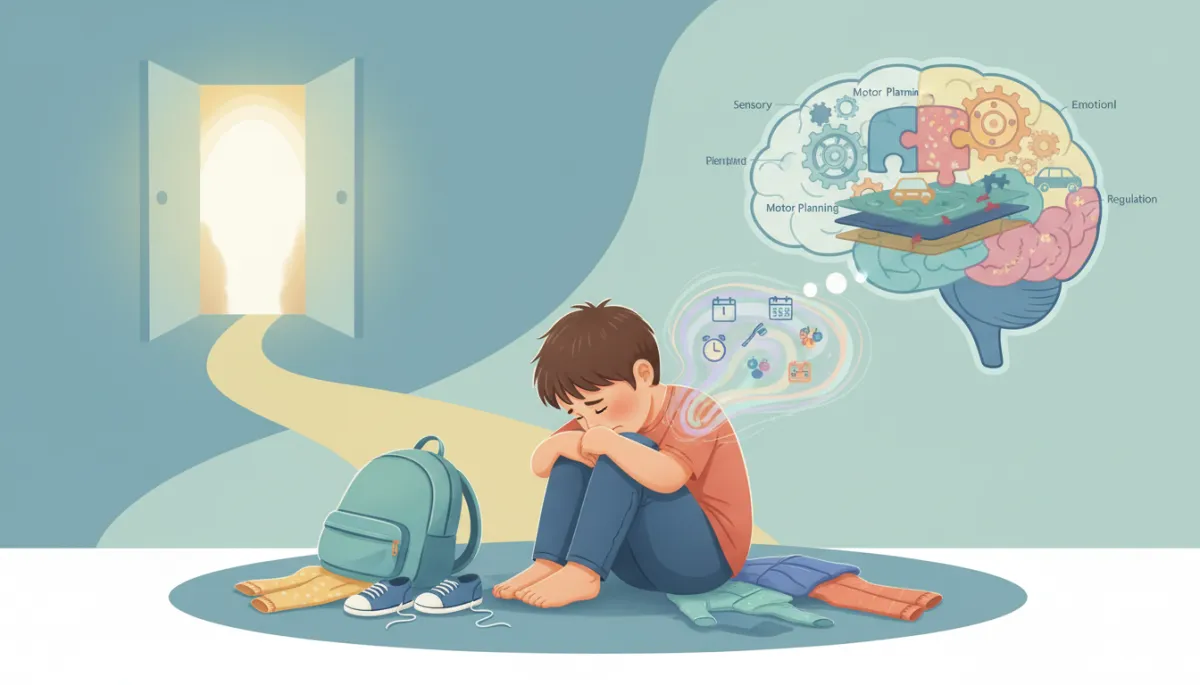
Understanding Child Meltdowns in Daily Routines
Parenting, Child Development, Occupational Therapy
Why does my child have daily meltdowns during simple routines like getting dressed or leaving the house?
Daily meltdowns during routines are often a sign that something about the task is harder for your child than it appears. The challenge may be sensory, motor, emotional, developmental, or a combination of several factors. When I work with families, I often find that the meltdown itself is not the primary problem. The meltdown is usually the child's way of communicating that a routine feels overwhelming, uncomfortable, confusing, or impossible to manage independently.
Key takeaways about daily routine meltdowns
Why do simple routines trigger such big reactions?
Parents often tell me:
"Getting dressed takes 30 minutes."
"Leaving the house turns into a battle every morning."
"Brushing teeth ends in tears."
"Everything falls apart when we need to transition."
The important thing to understand is that these routines are not actually simple. Under the surface, they rely on many skills working together smoothly.
Getting dressed: more complex than it looks
Getting dressed requires:
Sensory processing
Motor planning
Balance
Coordination
Attention
Sequencing
Frustration tolerance
Flexibility
Leaving the house: hidden transition challenges
Leaving the house requires:
Stopping a preferred activity
Transitioning attention
Managing time pressure
Following multiple directions
Handling unexpected changes
A child who struggles in any of these areas may experience a routine very differently than an adult does. What feels like “no big deal” to you can feel like a complex, high-pressure sequence to them.
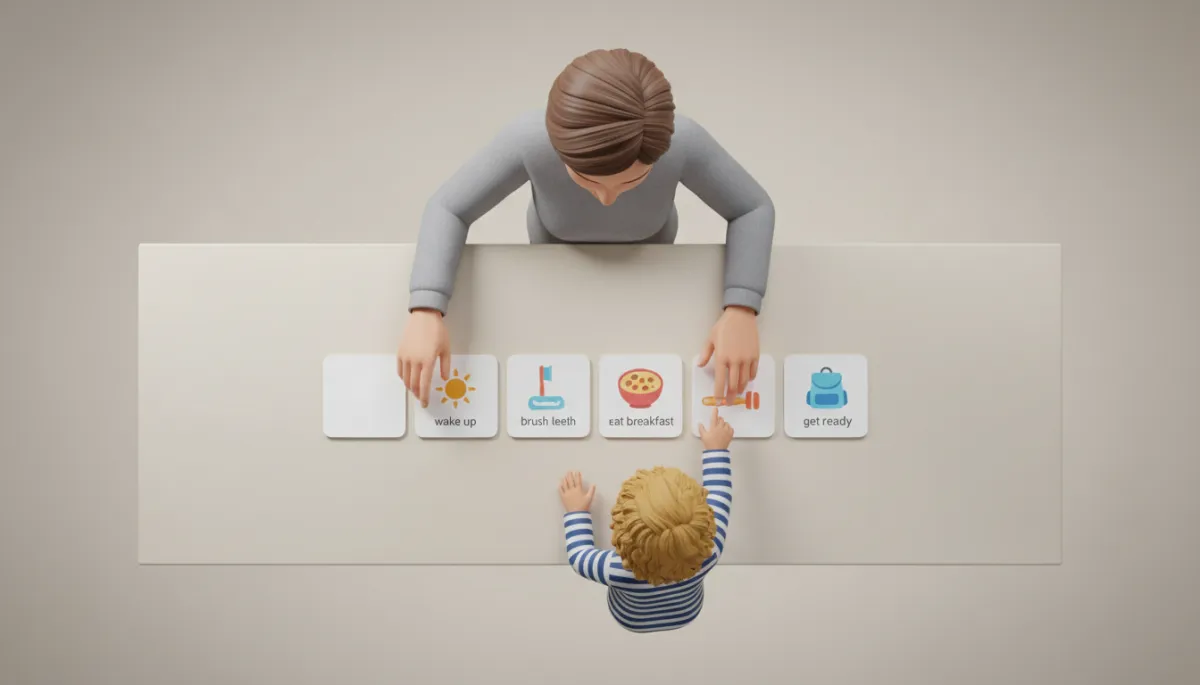
Breaking routines into clear, predictable steps often reduces daily meltdowns.
Could sensory sensitivities be causing the meltdowns?
Yes. Sensory processing challenges are one of the most common reasons I see daily routine meltdowns. Sensory processing differences mean your child’s brain may register certain sounds, textures, movements, or lights as much more intense than you do, or may not register them enough without extra input.
During dressing
A child may be bothered by:
Clothing tags
Sock seams
Tight waistbands
Certain fabrics
Temperature changes
What looks like refusal may actually be discomfort. From the outside, it can seem like “won’t,” but from the inside it is often “can’t tolerate.”
During hygiene routines
Children may react strongly to:
Toothbrush textures
Hair brushing
Water on the face
Loud bathroom sounds
During transitions
Some children become overwhelmed by:
Noise
Crowds
Busy environments
Multiple sensory inputs occurring at once
If you suspect sensory challenges may be contributing, see: "What is the best evaluation for sensory concerns in children?"
Could motor skill difficulties be contributing?
Absolutely. Many parents assume their child is resisting a task when the child is actually struggling to perform it. Motor planning challenges (figuring out how to move the body in the right order) and fine motor difficulties can turn everyday routines into exhausting work.
Examples include:
Fastening buttons
Pulling on pants
Putting on socks
Managing zippers
Tying shoes
Children who experience repeated failure often become frustrated before the task even begins. Over time, the routine itself becomes associated with stress, so the meltdown you see may be a response to anticipated difficulty, not just the task in front of them.
What if my child seems capable sometimes but melts down other times?
This pattern is extremely common. Many developmental challenges are affected by:
Fatigue
Hunger
Stress
Environmental demands
Sensory overload
A child may appear fully capable one day and completely overwhelmed the next. That inconsistency often confuses parents because it can look intentional. In reality, the child's capacity may fluctuate depending on how much regulation and energy they have available in that moment.
Could anxiety or transitions be the real issue?
Yes. For some children, the hardest part of a routine is not the task itself. The challenge is the transition. Transition challenges can be especially intense around predictable daily routines like leaving for school or getting ready for bed.
Leaving the house means:
Ending a preferred activity
Facing uncertainty
Changing environments
Managing expectations
Children who struggle with flexibility or anxiety often experience transitions as significantly more stressful than adults realize. The resulting meltdown is frequently a response to the transition rather than the destination.
When should parents become concerned?
Occasional meltdowns are a normal part of childhood. I become more concerned when:
Meltdowns happen daily
The same routines trigger them repeatedly
The intensity seems disproportionate to the situation
The behavior is affecting family life
School concerns are also present
Parents feel they are constantly walking on eggshells
At that point, it is worth investigating whether an underlying developmental, sensory, motor, or emotional challenge is contributing. Persistent patterns are data, not a parenting failure.
How do I know whether my child needs an occupational therapy assessment?
The most important question is not whether the behavior is severe. The question is whether there is an underlying challenge that is interfering with everyday functioning. For a complete framework on deciding whether an evaluation makes sense, see "When is a private occupational therapy assessment worth it?"
If routines consistently break down despite your best efforts, an assessment can help identify why. A comprehensive occupational therapy evaluation may examine:
Sensory processing
Fine motor skills
Gross motor skills
Motor planning
Self-care skills
Emotional regulation
Executive functioning
Daily participation
What happens if we wait?
Sometimes challenges improve naturally. Other times, routine struggles become more entrenched because:
Avoidance increases
Anxiety grows
Family stress accumulates
Expectations increase with age
If you are unsure whether to act now or monitor the situation, read "Should I get a private OT assessment now or wait and see?"
Why identifying the cause matters
The most effective support depends on understanding why the meltdowns occur. A sensory-based meltdown requires different strategies than:
Anxiety-driven behavior
Motor planning difficulties
Fine motor challenges
Emotional regulation struggles
Without understanding the root cause, parents often end up trying solutions that never address the actual problem. This is one reason assessments can be so valuable: they help move families from guessing to understanding.
Frequently asked questions
Is it normal for my child to melt down every morning before school?
Occasional resistance is normal. Daily, intense meltdowns may indicate sensory, emotional, motor, or transition-related challenges that deserve closer investigation.
Can sensory issues cause tantrums during dressing?
Yes. Clothing textures, seams, temperature, and tactile sensitivities are common triggers for dressing-related meltdowns.
Why does my child only struggle during transitions?
Transitions require flexibility, emotional regulation, and shifting attention. Children who find these skills difficult often become overwhelmed when moving from one activity to another.
Should I be worried if the meltdowns only happen at home?
Not necessarily. Many children work hard to hold themselves together at school and release stress once they return to a safe environment. Home meltdowns can still be a sign that daily demands are exceeding their current capacity.