
Understanding Child Overreactions to Frustrations
Parenting, Child Development, Emotional Regulation
Why does my child overreact to small frustrations?
Looking at this through the lens of a senior software engineer, “big reactions to small problems” are a lot like a fragile system that crashes when one tiny request times out. The bug usually isn’t the request itself—it’s everything happening underneath: overloaded resources, missing safeguards, and unhandled edge cases. Children who overreact to small frustrations are very similar: what you see on the surface is just the visible error message, not the real root cause.
Children who seem to overreact to small frustrations are often struggling with emotional regulation, sensory processing, stress, anxiety, or developmental skills that make everyday challenges feel much bigger than they appear. What looks like an overreaction is usually a sign that a child is overwhelmed, not a sign that they are choosing to be dramatic.
Many parents find themselves thinking, “Why is my child having such a big reaction to something so small?” A broken crayon, the wrong snack, a mistake on homework, or being told “no” can sometimes trigger tears, yelling, or a full meltdown. As with debugging production issues, those visible symptoms are often just the tip of the iceberg; the real story is what the child’s nervous system has been processing all day.
Key takeaways (like a quick system summary)
Children rarely overreact intentionally; there is usually an underlying “root cause” for the emotional response.
Emotional regulation skills develop gradually throughout childhood, much like iteratively improving a complex codebase.
Sensory processing challenges, anxiety, and stress can make frustrations feel much bigger than they appear from the outside.
Small problems often trigger meltdowns when a child is already overloaded—just like a server that crashes under one more request.
Frequent overreactions may indicate a need for additional support and better “system design” for your child’s day.
Occupational therapy can help children build emotional regulation and coping skills, much like bringing in a specialist to refactor critical infrastructure.
💡 Pro Tip (Engineer’s edition): Treat your child’s big reactions like error logs. Don’t ignore them or punish the “log output.” Use them to trace back to the underlying conditions: overload, missing skills, or unrealistic expectations.
1. Why does my child overreact to small frustrations?
Children often overreact to small frustrations because they do not yet have the skills, capacity, or nervous system regulation needed to manage disappointment effectively. If we compare this to software, think of a service with no rate limiting, no graceful error handling, and no retries—of course it fails loudly when something unexpected happens.
Manage emotions
Cope with disappointment
Adapt to unexpected situations
Solve problems
Recover from frustration
A child who cries because their sandwich was cut incorrectly is usually not upset about the sandwich itself. The reaction is often the result of accumulated stress, overwhelm, or difficulty regulating emotions—like a final failing request after hours of high CPU usage. If your child experiences frequent emotional outbursts across many situations, you may also want to read the pillar article: Why does my child have so many meltdowns?
2. Emotional regulation difficulties: unhandled exceptions
Emotional regulation difficulties are one of the most common reasons children appear to overreact. Emotional regulation is like the part of a system that catches exceptions and decides whether to retry, log, or gracefully degrade instead of crashing the whole application.
Manage feelings
Recover from disappointment
Stay flexible
Calm themselves after becoming upset
Adjust to unexpected situations
Children who struggle with regulation often experience emotions very intensely. For them, even minor setbacks can trigger strong reactions because their emotional “response system” activates quickly and takes longer to calm down. If you are wondering whether your child’s emotional responses are typical, read When should I worry about emotional regulation?
3. Sensory processing challenges: constant background load
Sensory issues are like a process that’s constantly consuming CPU in the background. When a child’s nervous system is already working hard to process sensory input, there’s very little capacity left for handling additional frustrations.
Loud classroom noise
Bright lights
Clothing discomfort
Social demands
By the time a small problem occurs—spilling a drink, losing a toy—their nervous system may already be overloaded. The frustration becomes the final trigger rather than the real cause. If sensory processing may be contributing to your child’s emotional responses, read Can sensory issues cause meltdowns?
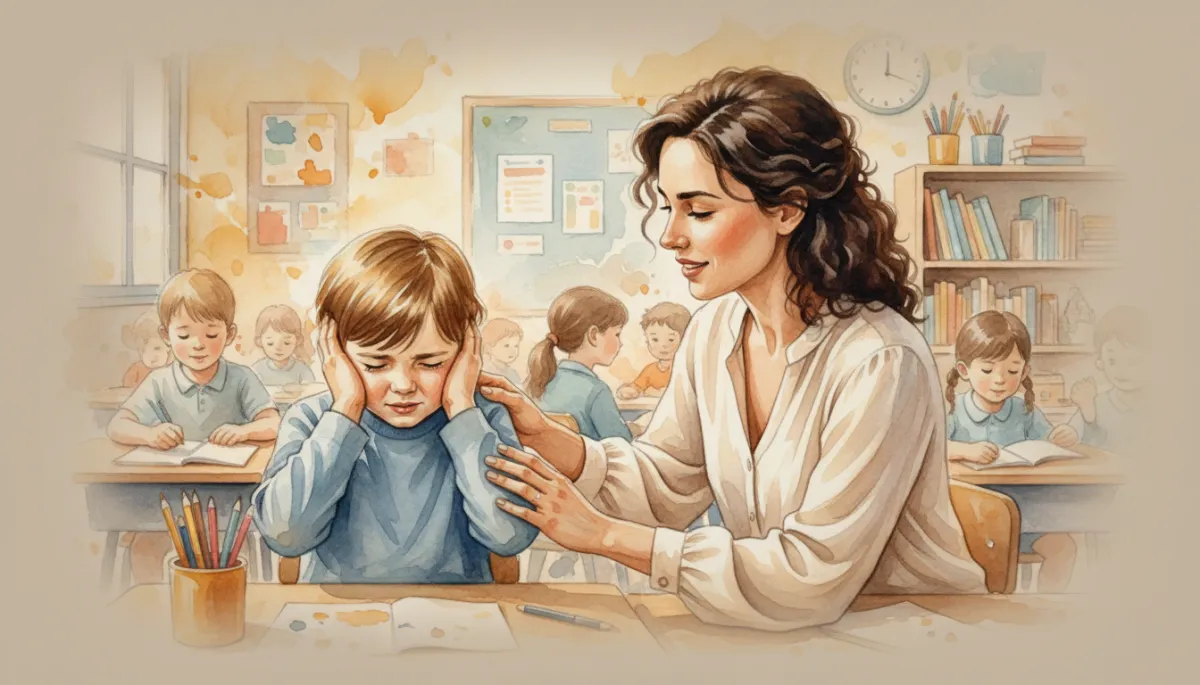
Sensory overload quietly drains capacity, making tiny frustrations feel unmanageable.
4. Anxiety: the brain’s “threat detection” running too hot
Anxiety is like an overly aggressive monitoring system that fires alerts for every tiny fluctuation. Children with anxiety often perceive situations very differently than adults do:
A small mistake may feel catastrophic.
An unexpected change may feel unsafe.
A minor social challenge may feel overwhelming.
Because anxiety increases the brain’s perception of threat, children may react strongly to situations that seem insignificant from an adult perspective. Parents often describe these children as worrying excessively, becoming upset easily, or having difficulty coping when things do not go exactly as expected.
5. Perfectionism: “all-or-nothing” thinking
Perfectionism in kids is like a build pipeline that treats any warning as a fatal error. A slightly crooked drawing, a missed homework problem, or a minor change in routine can feel like total failure. For a perfectionistic child, “good enough” doesn’t exist yet, so small frustrations hit very hard.
6. Fatigue: low battery, low tolerance
Fatigue significantly affects emotional regulation. A tired child is like a laptop running on 5% battery with power-saving mode off—performance drops, and everything feels harder. Tired children struggle more to:
Manage emotions and solve problems
Cope with disappointment and remain flexible
Recover from stress
This is why parents often see more emotional reactions after school, before dinner, at bedtime, or during busy weekends. When the system is low on energy, even tiny frustrations can trigger a shutdown.
7. Executive functioning challenges: missing “orchestration layer”
Executive functioning is the brain’s project manager: planning, organizing, shifting tasks, and holding information in mind. When these skills are still developing or delayed, everyday tasks feel like poorly coordinated microservices with no central control.
Getting dressed, packing a backpack, or starting homework may already feel overwhelming.
A small change—like a missing shoe—can push the whole routine into chaos.
In this state, a tiny frustration is not “one more thing”; it is the thing that makes the whole system feel like it’s failing.
8. Stress: running in constant high-alert mode
Ongoing stress—changes at home, school demands, social pressures—keeps a child’s nervous system in “high-alert” mode. It’s like a production system under constant heavy traffic: there’s no time to recover, so resilience drops. Under chronic stress, children:
Have less patience for delays or changes
React more strongly to minor frustrations
Take longer to calm down once upset
9. Developmental delays: skills still “under construction”
Some children develop emotional, sensory, or cognitive skills on a different timeline. This is like running an early beta in a production-like environment: the core features are there, but some modules are still unstable. Developmental delays can affect:
Emotional awareness and self-regulation
Language and communication (making it harder to express needs calmly)
Motor skills, which can make everyday tasks more frustrating
When expectations don’t match a child’s current developmental stage, frustration and “overreactions” are almost guaranteed.
10. Can occupational therapy help children who overreact to frustration?
Yes. Occupational therapy (OT) is like bringing in a senior systems architect for your child’s daily life. Instead of focusing only on the visible behavior, occupational therapists look at the whole stack:
Sensory processing
Emotional regulation
Executive functioning and attention
Daily routines and environmental demands
At Kerrie Rowe OT, families throughout Newport Beach, Costa Mesa, and surrounding Orange County communities often seek support when emotional reactions are affecting daily life. Through comprehensive assessments and individualized treatment plans, parents gain a clearer understanding of why their child is struggling and what strategies can help. If you would like to learn more about private occupational therapy services, visit:
You can also learn more in the related article: Can OT help with meltdowns?
📌 Key Takeaway: OT doesn’t just “fix behavior”; it builds capacity, skills, and better environments so small frustrations no longer crash the whole system.
What can parents do when their child overreacts?
The most helpful first step is curiosity. Instead of asking:
“Why are they making such a big deal out of this?”
Try asking:
“What is making this situation so difficult for them?”
As engineers, we don’t blame the server for throwing a 500; we inspect logs, metrics, and context. You can do the same with your child by watching for patterns:
When do reactions happen (time of day, before/after school)?
What tends to trigger them (transitions, mistakes, sensory overload)?
Is your child tired, hungry, or already stressed?
Do sensory issues or anxiety seem to play a role?
Frequently asked questions
Why does my child cry over little things?
Children often cry over small things because they are still developing emotional regulation skills. Stress, fatigue, anxiety, and sensory challenges can all make minor frustrations feel much bigger than they look from the outside.
Is it normal for children to overreact?
Some overreacting is a normal part of childhood development—like early versions of any system being less stable. But frequent, intense, or disruptive reactions that interfere with daily life deserve closer attention and possibly professional support.
Can sensory issues cause emotional overreactions?
Yes. Sensory overload can dramatically reduce a child’s ability to manage emotions and cope with everyday frustrations, making small problems feel like the last straw.
Why does my child get so upset when things do not go their way?
Many children struggle with flexibility and disappointment, especially if perfectionism, anxiety, or developmental factors are involved. When expectations and reality diverge, they may not yet have the coping tools to bridge that gap calmly.
Can occupational therapy help with emotional regulation?
Yes. Occupational therapy can help children build regulation skills, improve frustration tolerance, and better manage everyday challenges by addressing sensory needs, routines, and underlying skill gaps—not just the outward behavior.
Final thoughts
When children overreact to small frustrations, the issue is rarely the small problem itself. More often, the emotional response is a sign that something else—sensory processing challenges, emotional regulation difficulties, anxiety, fatigue, stress, or developmental factors—is making it hard for them to cope. As with any complex system, once you understand the architecture and the bottlenecks, you can design better supports. Looking beyond the behavior and toward the underlying causes allows parents, therapists, and children to work together on building resilience, capacity, and confidence for all the inevitable “small bugs” life will throw their way.