Understanding Emotional Regulation in Children
Parenting, Emotional Regulation, Occupational Therapy
When Should I Worry About Emotional Regulation? A Developer’s Guide to Reading the “Logs” in Your Child’s Behavior
As a senior software developer, I spend my days debugging complex systems, tracing logs, and looking for the root cause behind unexpected behavior. Parenting a child with big emotions can feel surprisingly similar. You see “errors” (meltdowns, outbursts, shutdowns) in the system, but it’s hard to know when this is just normal load… and when it’s a sign that something deeper needs attention. This article walks through that question step‑by‑step, using the exact framework below and the full text you provided as our “spec.”
When should I worry about emotional regulation?
When should I worry about emotional regulation?
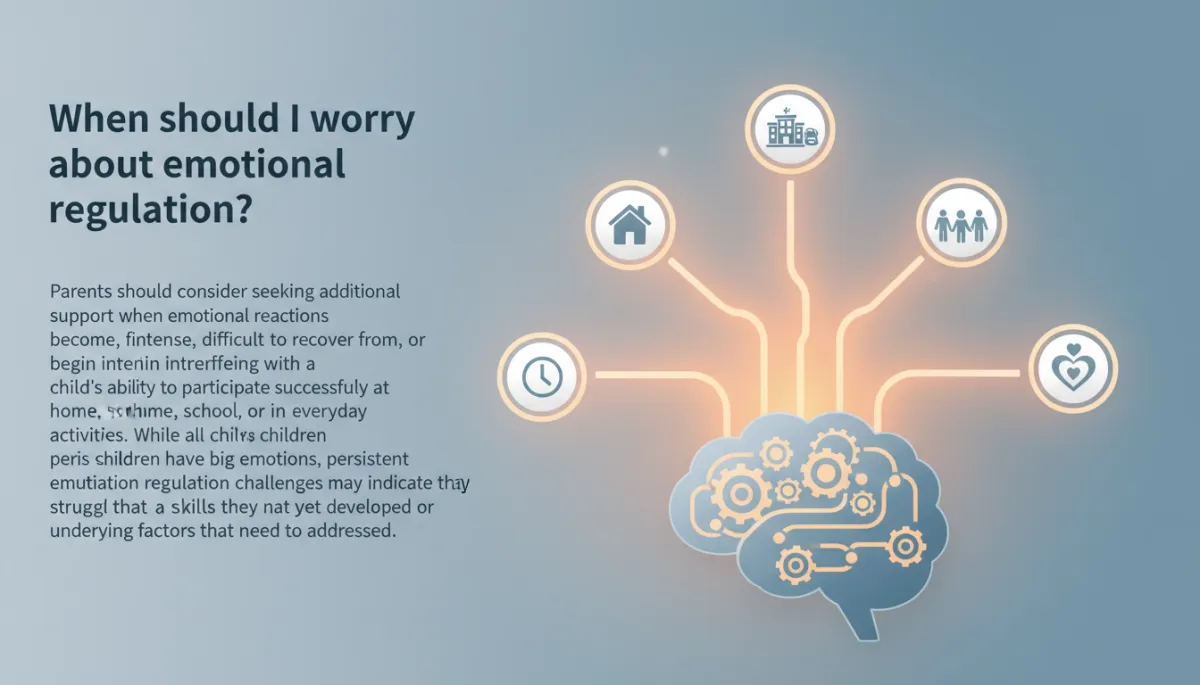
Parents should consider seeking additional support when emotional reactions become frequent, intense, difficult to recover from, or begin interfering with a child's ability to participate successfully at home, school, or in everyday activities. While all children have big emotions, persistent emotional regulation challenges may indicate that a child is struggling with skills they have not yet developed or underlying factors that need to be addressed.
Many parents wonder whether their child's emotional reactions are simply part of development or whether something more is going on. It can be difficult to know when frequent meltdowns, frustration, anxiety, or emotional outbursts fall outside the typical range.
The good news is that emotional regulation difficulties often leave clues. Understanding what those clues look like can help parents determine when it may be time to seek additional support.
Think of these reactions like recurring exceptions in a production system: one or two might be noise; frequent, severe, or user‑impacting errors usually mean it’s time to investigate.
Key takeaways (like a concise README)
Key takeaways
Emotional regulation skills develop gradually throughout childhood.
Occasional meltdowns and emotional outbursts are a normal part of development.
Frequent, intense, or prolonged emotional reactions may indicate a need for further evaluation.
Sensory processing challenges, anxiety, executive functioning difficulties, and stress can affect emotional regulation.
The impact on daily life is often more important than the behavior itself.
Occupational therapy can help identify and address the factors contributing to emotional regulation challenges.
What is emotional regulation?
What is emotional regulation?
Emotional regulation is the ability to recognize, manage, and recover from emotions in a way that allows a child to participate successfully in everyday activities.
These skills help children:
Handle disappointment
Adapt to change
Manage frustration
Cope with stress
Solve problems
Recover after becoming upset
Emotional regulation is not something children automatically know how to do. It develops gradually through experience, support, and skill-building.
Some children naturally develop these skills more easily than others. Some need additional support because of sensory processing challenges, anxiety, developmental differences, or other factors.
In engineering terms, emotional regulation is like a rate limiter, circuit breaker, and retry strategy for the nervous system—helping a child throttle reactions and recover after “failures.”
When should parents start to worry about emotional regulation?
When should parents start to worry about emotional regulation?
Parents should become concerned when emotional reactions consistently interfere with daily functioning.
Some warning signs include:
Frequent meltdowns
Extreme reactions to minor problems
Difficulty calming down
Emotional outbursts that seem disproportionate to the situation
Ongoing struggles at school
Challenges maintaining friendships
Avoidance of age-appropriate activities
Significant family stress
The concern is not that children become upset. All children become upset.
The concern is when emotions regularly prevent a child from participating successfully in everyday life.
If your child experiences frequent emotional outbursts across multiple situations, you may also want to read Why does my child have so many meltdowns?
How often are emotional outbursts considered typical?
How often are emotional outbursts considered typical?
There is no exact number that separates typical behavior from a concern.
Instead, parents should look at:
Frequency
Intensity
Duration
Recovery time
Impact on daily functioning
For example, a child who becomes upset occasionally but recovers quickly may not require additional support.
A child who experiences daily meltdowns, struggles to recover, and consistently has difficulty participating in routines may benefit from further evaluation.
What are signs that emotional reactions are becoming excessive?
What are signs that emotional reactions are becoming excessive?
Emotional reactions may deserve closer attention when a child:
Melts down over small frustrations regularly
Has difficulty calming even with support
Appears emotionally overwhelmed most days
Becomes stuck on disappointments
Has trouble adapting to change
Experiences emotional outbursts that seem to be increasing
Many parents describe feeling as though they are constantly walking on eggshells because they never know what might trigger the next meltdown.
If your child often has large reactions to minor problems, read Why does my child overreact to small frustrations?

-toned photo of a parent quietly taking notes on a clipboard while observing their child playing...
Tracking patterns over time helps parents see when big emotions need extra support.
Is it normal for a 5-year-old to struggle with emotional regulation?
Is it normal for a 5-year-old to struggle with emotional regulation?
Yes. Emotional regulation skills are still developing at age five.
However, there is a difference between age-appropriate emotional development and emotional challenges that significantly interfere with daily life.
Parents should pay attention to whether their child is gradually improving over time or whether emotional difficulties seem to be staying the same or becoming more intense.
For a more detailed discussion, read Is it normal for a 5-year-old to have daily meltdowns?
Can sensory processing difficulties affect emotional regulation?
Can sensory processing difficulties affect emotional regulation?
Absolutely.
Sensory processing and emotional regulation are closely connected.
When a child's nervous system is overwhelmed by sensory input, emotional regulation becomes much more difficult.
Children may become upset because of:
Loud sounds
Clothing textures
Bright lights
Crowded environments
Unexpected touch
Sensory overload
Parents sometimes focus on the emotional reaction without realizing that sensory challenges are contributing to the behavior.
If you suspect sensory processing may be involved, read Can sensory issues cause meltdowns?
Why do emotional regulation problems often show up during transitions?
Why do emotional regulation problems often show up during transitions?
Transitions require flexibility, attention shifting, and emotional adjustment.
Children who struggle with regulation often have difficulty:
Ending preferred activities
Starting non-preferred activities
Adapting to unexpected changes
Managing uncertainty
As a result, transitions become one of the most common triggers for emotional outbursts.
If this is a challenge for your child, read Why does my child have tantrums during transitions?
Why does my child seem unable to calm down once upset?
Why does my child seem unable to calm down once upset?
Many children who struggle with emotional regulation have difficulty returning to a calm state once their nervous system becomes activated.
This does not mean they are choosing to stay upset.
Instead, they may lack the skills needed to:
Recognize emotions early
Use coping strategies
Recover from stress
Regulate sensory input
Children often need adult support while these skills are developing.
One important sign that further support may be helpful is when recovery times become unusually long or continue to worsen over time.
Could morning meltdowns be a sign of emotional regulation difficulties?
Could morning meltdowns be a sign of emotional regulation difficulties?
Yes.
Morning routines place significant demands on emotional regulation skills.
Children must:
Wake up
Transition between tasks
Manage time pressure
Handle sensory experiences
Prepare for school
For children who struggle with regulation, mornings often become one of the most challenging parts of the day.
If mornings are consistently difficult, read Why does my child melt down every morning?
What causes emotional regulation difficulties?
What causes emotional regulation difficulties?
Emotional regulation challenges can result from many different factors.
Common contributors include:
Sensory processing challenges
Children who become overwhelmed by sensory input often struggle to regulate emotions effectively.
Anxiety
Anxiety increases stress on the nervous system and can make emotional reactions more intense.
Executive functioning difficulties
Challenges with flexibility, planning, organization, and impulse control can affect emotional regulation.
Developmental differences
Some children naturally require more support developing emotional regulation skills.
Chronic stress
Children experiencing ongoing stress often have fewer resources available for managing emotions.
Understanding the underlying cause is essential because different causes require different solutions.
When should parents seek professional support?
When should parents seek professional support?
Parents should consider seeking professional guidance when:
Emotional outbursts are occurring frequently
Daily life is becoming difficult
School participation is affected
Family routines are disrupted
Emotional reactions are becoming more intense
The child appears consistently overwhelmed
Seeking support does not mean something is wrong with your child.
It simply means you want to better understand what they are experiencing and how to help.
Can occupational therapy help with emotional regulation?
Can occupational therapy help with emotional regulation?
Yes.
Occupational therapy can help children develop the skills needed to manage emotions, cope with challenges, and participate more successfully in everyday activities.
Rather than focusing only on behavior, occupational therapists examine the underlying factors contributing to emotional regulation difficulties, including:
Sensory processing
Executive functioning
Daily routines
Environmental demands
Participation challenges
Coping skills
At Kerrie Rowe OT, families throughout Newport Beach, Costa Mesa, and surrounding Orange County communities often seek support when emotional outbursts, frustration, or regulation difficulties are affecting daily life. Through comprehensive assessments and individualized treatment plans, families gain a better understanding of why their child is struggling and what strategies can help.
If you would like to learn more about private occupational therapy services, visit:
Kerrie Rowe OT
For additional information, read Can OT help with meltdowns?
What should parents do if they are concerned?
What should parents do if they are concerned?
Start by observing patterns.
Consider:
When emotional outbursts occur
What triggers them
How long they last
How your child recovers
Whether sensory or environmental factors are involved
These observations often reveal valuable information about what is contributing to your child's struggles.
The goal is not to eliminate emotions. The goal is to help children develop the skills needed to experience emotions without becoming overwhelmed by them.
Frequently asked questions (FAQ) about emotional regulation and OT
What are signs of emotional regulation problems in children?
Common signs include frequent meltdowns, difficulty calming down, extreme reactions to minor frustrations, challenges with transitions, and emotional responses that interfere with daily life.
At what age should emotional regulation improve?
Emotional regulation develops throughout childhood. Most children gradually become better at managing emotions as they gain experience and develop coping skills.
Can sensory issues affect emotional regulation?
Yes. Sensory overload can significantly impact a child's ability to manage emotions and respond appropriately to everyday situations.
Should I worry if my child has daily meltdowns?
Daily meltdowns are worth investigating, particularly if they are affecting participation at home, school, or in the community.
Can occupational therapy help emotional regulation?
Yes. Occupational therapy can help children build regulation skills, improve coping strategies, address sensory challenges, and increase participation in everyday activities.
Final thoughts
Final thoughts
All children experience big emotions from time to time. Emotional regulation is a skill that develops gradually and requires practice, support, and experience.
However, when emotional reactions become frequent, intense, or disruptive, it may be a sign that a child needs additional support.
Rather than focusing only on the behavior itself, it is often more helpful to ask: What is making emotional regulation difficult for my child?
Whether the answer involves sensory processing, anxiety, executive functioning, transitions, or another challenge, understanding the underlying cause is often the first step toward helping your child feel more successful, confident, and emotionally regulated.